Fountain Pen Nib Sizes Explained: EF, F, M and B
Nib letters name the line a fountain pen writes: EF (extra fine), F (fine), M (medium), B (broad). They aren't a standard. Goldspot measured a German JoWo steel nib at 0.30, 0.35, 0.50 and 0.55 mm, and Goldspot says Japanese nibs, especially Sailor and Platinum, write about one size finer.
On this page
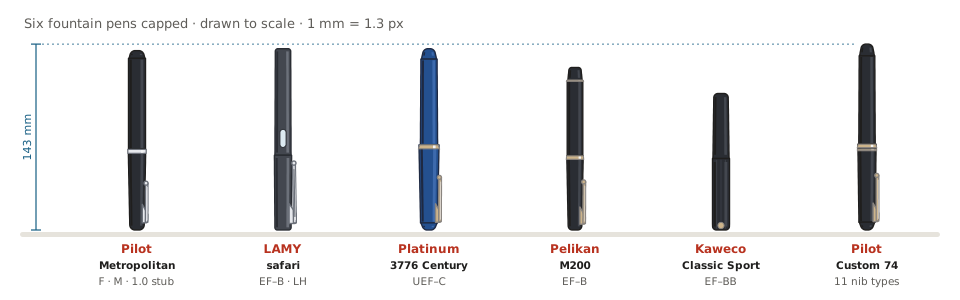
Products compared
| Product | Brand origin | Made in | Price range |
|---|---|---|---|
| Pilot Metropolitan Fountain PenPilot | Japan | Japan* | Price range: $$$ |
| LAMY safari Fountain PenLAMY | Germany | Germany* | Price range: $$$ |
| Platinum #3776 Century Fountain Pen (Chartres Blue, gold trim)Platinum | Japan | Japan* | Price range: $$$$ |
| Pelikan Classic M200 Fountain Pen (Black, gold-plated trim)Pelikan | Germany | Germany* | Price range: $$$$ |
| Kaweco Classic Sport Fountain PenKaweco | Germany | Germany* | Price range: $$$ |
| Pilot Custom 74 Fountain Pen (black, gold trim)Pilot | Japan | Japan* | Price range: $$$$ |
Notes on these facts
- Pilot Metropolitan Fountain Pen: Made by Pilot Corporation (Japan); sold in the US by Pilot Corporation of America. Made in Japan: per Milligram's listing (made in Japan). Pilot's Japanese catalog page for the Cocoon (read in full on October 20, 2026) doesn't state a country. eBay and Rokomari listings cited earlier blocked our access on that date, so we dropped them. Source. Price: example listing. Released: Pilot's Japanese site says the Cocoon, the Metropolitan's Japanese sibling, went on sale in 2012; Wikipedia gives 2012 for the Metropolitan. We found no Pilot page dating the Metropolitan itself.
- LAMY safari Fountain Pen: Made by C. Josef Lamy GmbH, Heidelberg (part of Mitsubishi Pencil Co., Ltd.). Made in Germany: LAMY's own product listing (India storefront) gives Germany as the country of origin and names C. Josef Lamy GmbH, Heidelberg, as the manufacturer, and also says made in Germany. LAMY's German page names no country. Source. Price: example listing. Released: Museum Boijmans and LAMY's India listing give 1980; LAMY's German page says the safari was introduced in the 1980s.
- Platinum #3776 Century Fountain Pen (Chartres Blue, gold trim): Made by Platinum Pen Co., Ltd. (Tokyo). Made in Japan: Unsharpen's review says the band reads "Platinum #3776 Century Made in Japan". Platinum's own English pages don't state it in the sources we found. Source. Price: example listing. Released: Platinum's January 29, 2026 press release says the #3776 brand began in 1978 and the Century with Slip & Seal was born in 2011; we found no exact launch month.
- Pelikan Classic M200 Fountain Pen (Black, gold-plated trim): Made by Pelikan Group GmbH (Germany), owned by Hamelin since December 13, 2023. Made in Germany: Pelikan's German product page for the Classic 200 Schwarz says "Gefertigt und montiert in Deutschland" (made and assembled in Germany) and "Qualität, made in Germany". Source. Price: example listing. Released: Per the Pelikan's Perch collectors' database; Pelikan restyled the trim in 1997. Pelikan doesn't give a launch year on its product page.
- Kaweco Classic Sport Fountain Pen: Made in Germany: Kaweco's German product page labels the Classic Sport "100% Made in Germany" and says all nibs and the pen itself are made in Germany; its series page says Classic Sport pens are produced and assembled in Germany. Cornelissen says hand assembled in Germany, and Milligram says designed and made in Germany. Source. Price: example listing. Released: Kaweco dates the first Sport pocket pen to 1911; Pen Chalet says the Classic Sport follows the original 1935 design.
- Pilot Custom 74 Fountain Pen (black, gold trim): Made by Pilot Corporation (Japan); sold in the US by Pilot Corporation of America. Made in Japan: per retailer listings: Makkura gives Japan as the origin, and eBay item specifics from sellers in Japan list Japan as the country of origin. Pilot's Japanese web catalog and press release don't state it; the 2022 anniversary edition's cap ring is engraved JAPAN. Source. Price: example listing. Released: Pilot's Japanese press release for the 30th-anniversary model (November 18, 2022) says the Custom 74 went on sale in 1992; Goulet Pens gives the same year and ties the name to Pilot's 74th anniversary.
- Price bands are typical US retail, checked October 2026.
Key takeaways
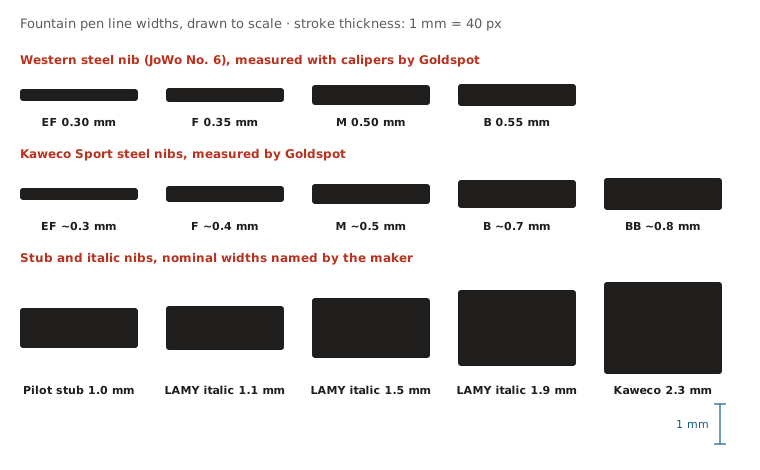
- Goldspot measured a German JoWo No. 6 steel nib with calipers at EF 0.30 mm, F 0.35 mm, M 0.50 mm and B 0.55 mm.
- Goldspot measured Kaweco Sport nibs at about 0.3 (EF), 0.4 (F), 0.5 (M), 0.7 (B) and 0.8 mm (BB).
- None of the six makers we checked (Pilot, Platinum, Sailor, LAMY, Pelikan, Kaweco) publishes a millimetre width for EF to B; only stub and italic nibs carry widths, from 1.0 to 2.3 mm.
- A Japanese M writes about like a Western F, per Goldspot; Platinum's 14k #3776 Century runs from UEF to C, and Pilot offers 11 nib types on the Custom 74.
- For small handwriting, LAMY says to go finer and Pelikan names EF or F; LAMY sells a dedicated LH nib for left-handers, while Pelikan says left-handers can use any of its sizes.
What do fountain pen nib sizes (EF, F, M, B) mean?
The letters describe how wide a line the nib writes: EF is extra fine, F fine, M medium and B broad, with BB (double broad) above. They are each maker’s own grades, not a standard, so one brand’s F can write like another brand’s M.
Goldspot, a US pen shop, measured a German JoWo No. 6 steel nib with digital calipers at 0.30, 0.35, 0.50 and 0.55 mm from EF to B. It says most fine nibs write between 0.30 and 0.45 mm, with Japanese nibs at the finer end. Line width also changes with paper, ink and pressure.
How wide is each nib size in millimetres?
About 0.3 mm for EF and 0.5 mm for M on Western steel nibs, as measured by a retailer; no maker we checked publishes millimetre widths for EF to B.
| Size | Name | JoWo No. 6 (Goldspot, calipers) | Kaweco Sport (Goldspot) | Japanese sizing |
|---|---|---|---|---|
| EF | Extra fine | 0.30 mm | ~0.3 mm | Finer; Platinum adds UEF |
| F | Fine | 0.35 mm | ~0.4 mm | About a Western EF |
| M | Medium | 0.50 mm | ~0.5 mm | About a Western F |
| B | Broad | 0.55 mm | ~0.7 mm | About a Western M |
| BB | Double broad | Not measured | ~0.8 mm | Pilot and Kaweco sell it |
The Japanese column follows Goldspot’s rule of thumb. The Kaweco figures come from new pens measured with a transparent gauge, which Goldspot says is less precise than calipers.
What sizes does each maker sell?
Every maker uses the same letters, but the range and the extras differ, and only stub and italic nibs come with a width in millimetres.
| Maker (example pen) | Standard sizes | Specialty nibs | Published mm |
|---|---|---|---|
| Pilot (Custom 74) | EF, F, SF, FM, SFM, M, SM, B, BB | 11 types in Japan, incl. MS (music) | None |
| Pilot (Metropolitan) | F, M | 1.0 mm stub | Stub only |
| Platinum (#3776 Century) | UEF, EF, F, SF, M, B, C | SF soft fine | None |
| Sailor (Profit 14) | EF, F, MF, M, B | Naginata, Cross Point | None |
| LAMY (safari) | EF, F, M, B | LH, A (beginner); italic | 1.1, 1.5, 1.9 mm italics |
| Pelikan (M200) | EF, F, M, B | Italic at size 800 only | None |
| Kaweco (Classic Sport) | EF, F, M, B, BB | Calligraphy | 1.1, 1.5, 1.9, 2.3 mm |
Pilot’s Japanese nib page describes each grade by use and holding angle rather than width. Platinum labels its Preppy nibs 02 EF, 03 F and 05 M, and its 2014 press release says the numbers make the line width easy to tell.
Why do Japanese nibs write finer?
Japanese makers grade their nibs finer, so a Japanese F writes about like a European EF. Goldspot says a Western medium is more like a Japanese broad, and singles out Sailor and Platinum as running thinnest; it also finds Pilot’s steel Metropolitan nib finer than LAMY’s same size.
Pelikan, for its part, recommends EF or F for small handwriting and for Asian characters. If you are moving from a Japanese pen to a German one, go one size finer.
What are stub, italic and flex nibs?
Stub and italic nibs have a flat, wide tip that writes thick downstrokes and thin cross strokes; a flex nib spreads its tines under pressure to vary the line.
- Stub: rounded edges, smoother, mild contrast. The Pilot Metropolitan comes with a 1.0 mm stub; Pilot’s Japanese range adds SU and MS nibs that write wide verticals and thin horizontals.
- Italic: crisper edges and more contrast. LAMY sells Z50 italics at 1.1, 1.5 and 1.9 mm; Kaweco’s calligraphy nibs run 1.1 to 2.3 mm.
- Flex and soft: Pilot’s FA (Falcon) is its softest, brush-like nib, and Pilot says it isn’t for heavy-handed writers. Goldspot calls modern flex nibs semi-flexible and doesn’t recommend them to beginners.
Goldspot measured a 1.1 mm stub at 0.75 mm on downstrokes and 0.40 mm across.
Which nib size suits small handwriting or a left hand?
For small handwriting, choose EF or F; for a left hand, a fine nib that puts down little ink dries fastest. LAMY puts it plainly: the smaller the handwriting, the finer the nib.
- Small handwriting or planners: EF or a Japanese F, such as Platinum’s UEF or EF on the #3776 Century.
- Everyday notes: F, or M on a Japanese pen. Kaweco recommends M to beginners.
- Signatures and showing off ink: B, BB or a stub.
- Left hand: LAMY sells an LH nib, ground for left-handers, for the safari and its other pens. Pelikan says left-handers can use any of its sizes but should test an italic before buying, and Goldspot warns that broad nibs dry slowly.
Pilot also matches nibs to how you hold the pen: its Japanese guide says EF suits writers who hold the pen upright and BB those who hold it slightly lower.
Frequently asked questions
What does EF mean on a fountain pen?
EF stands for Extra Fine, the finest nib most makers sell as standard. Goldspot measured a German JoWo steel EF at 0.30 mm; Japanese EF nibs write finer still, and Platinum adds an Ultra Extra Fine (UEF) below it.
Is a fine nib 0.5 mm?
Usually not. Nib letters aren't millimetre sizes, and Goldspot says most fine nibs write between 0.30 and 0.45 mm, with Japanese nibs at the finer end. A 0.5 mm gel pen tip is a ball size, not a nib grade.
Do Japanese nibs run finer than European nibs?
Yes, generally by about one size. Goldspot says a Western medium is more like a Japanese broad and a Japanese medium behaves like a Western fine, and names Sailor and Platinum as running thinnest.
Which nib size is best for small handwriting?
EF or F. LAMY says the smaller the handwriting, the finer the nib should be, and Pelikan recommends EF or F for small or tight writing and for Asian characters; a Japanese F writes finer than a German F.
Which fountain pen nib is best for left-handed writers?
A fine round nib that dries quickly is the safe start. LAMY sells a dedicated LH nib for the safari, Pelikan says left-handers can use any of its sizes, and Goldspot warns that broad nibs dry slowly, which matters for left-handers.
What is the difference between a stub and an italic nib?
Both have a flat, wide tip that writes broad downstrokes and thin cross strokes. A stub is rounded at the edges and smoother, like Pilot's 1.0 mm Metropolitan stub; an italic is sharper, like LAMY's 1.1, 1.5 and 1.9 mm Z50 nibs.
Are flex nibs good for beginners?
No. Goldspot says modern flex nibs are only semi-flexible and that beginners risk springing them by pressing too hard. Pilot says its very soft FA (Falcon) nib suits light writers and isn't for heavy-handed ones.
Can I change the nib on my fountain pen?
On many pens, yes. LAMY nibs pull off and push on by hand, Kaweco sells front sections with each nib width, and Pelikan's M200 has a screw-out nib unit. Check your pen's guide before pulling a nib.
Sources
- Pilot (Japan): 万年筆のペン先の種類 (fountain pen nib types: EF, F, SF, FM, SFM, M, SM, B, BB, C, MS, PO, FA, WA, SU, with uses and holding angles)
- Pilot (Japan) web catalog: Custom 74 (14K No. 5 nib, 11 nib types, 143 mm, 17.4 g)
- Platinum (Japan): #3776 Century (nibs UEF, EF, F, SF, M, B, C; 139.5 mm, 20.5 g)
- Platinum press release, October 20, 2014: Preppy 02 EF nib; 03 F and 05 M labels make the line width easy to tell
- Sailor (Japan): Profit 14 fountain pen (nibs EF, F, MF, M, B)
- LAMY (Germany): Federspitzen-Guide (nib grades, M and LH round nibs, oblique nibs, small handwriting advice)
- LAMY (Germany): LAMY Z 50 Feder (EF to B, LH, A; italic 1.1, 1.5, 1.9 mm)
- Pelikan (Germany): Die Wahl der richtigen Feder (choosing a nib; EF or F for small writing; left-handers; italic at size 800)
- Pelikan (Germany): Classic 200 Schwarz (4 nib widths EF, F, M, B)
- Kaweco: Calligraphy Nibs 060 (1.1, 1.5, 1.9 and 2.3 mm)
- Kaweco: Nibs 060 (steel nibs, Extra Fine to Extra Broad, made in Germany)
- Kaweco (Germany): CLASSIC SPORT Füllhalter Schwarz (EF to BB, M recommended for beginners)
- Goldspot: How to find the right nib for your handwriting style (JoWo No. 6 line widths measured with calipers; Japanese vs Western sizing; flex)
- Goldspot: Kaweco Sport nib size comparison (measured line widths EF to BB)
- Goldspot: LAMY safari vs Pilot Metropolitan (Pilot's steel nib writes finer than LAMY's equivalent sizes)